
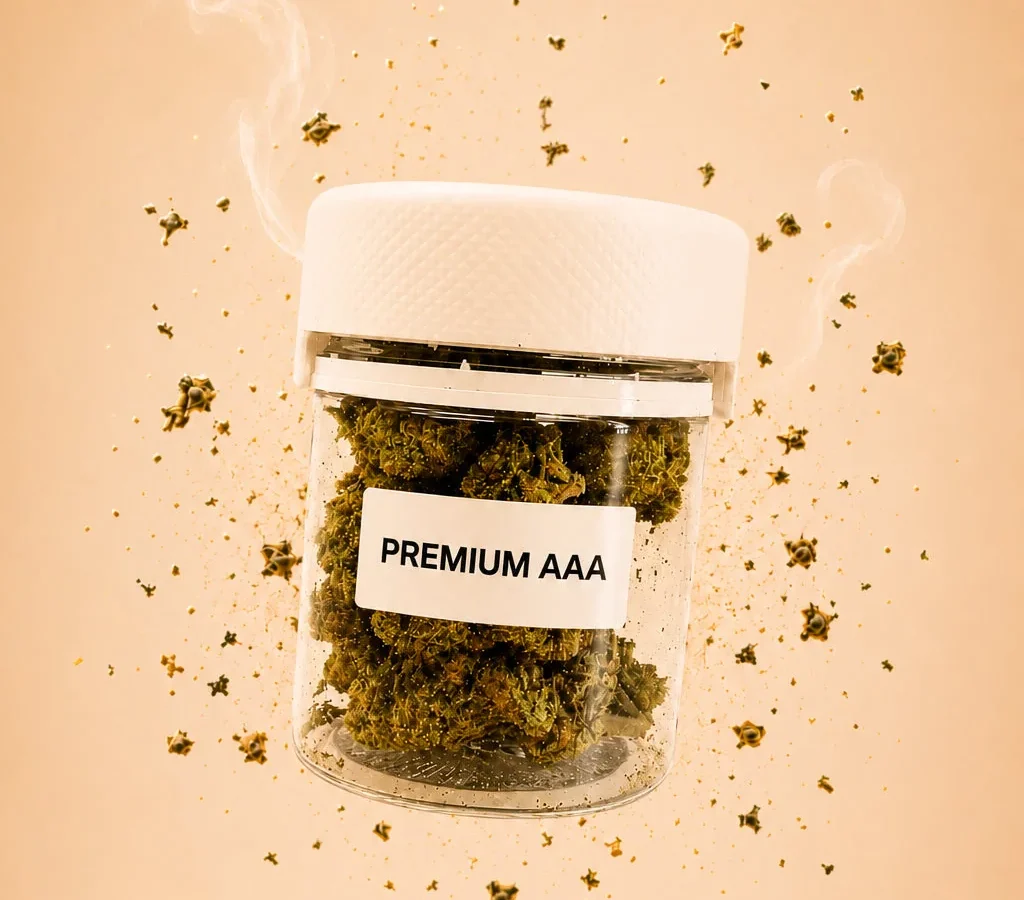
The cannabis plant produces more than a hundred cannabinoids. Three of them appear on almost every label: THC, THC-A and CBD. Their names are similar, but they are not the same thing.
THC (delta-9-tetrahydrocannabinol)
The main psychoactive cannabinoid in cannabis: it is what causes the "high". It is under international control and, in Portugal, THC products fall under the drug law or the medical cannabis framework.
THC-A (tetrahydrocannabinolic acid)
In the living plant and in dried flower, THC exists mostly in its acid form, THC-A. As it is, THC-A does not have the same psychoactive effect. But when heated (smoking, vaping or cooking) it loses a carboxyl group, a process called decarboxylation, and turns into THC. That is why a flower "rich in THC-A" behaves, once heated, like a flower rich in THC.
It is also why many labs report "total THC", which adds the THC present to the THC that forms from THC-A.
CBD (cannabidiol)
CBD is the second best-known cannabinoid. According to the World Health Organization, pure CBD showed no abuse or dependence potential and has no psychoactive effect like THC. The WHO stresses, however, that this is not a recommendation for use and that its legal status is decided by each country.
Quick comparison
| THC | THC-A | CBD | |
|---|---|---|---|
| Psychoactive | Yes | No, until heated (becomes THC) | No |
| Found in | Heated flower, extracts | Dried and fresh flower | Flower, extracts, hemp |
| Approved medicine in the EU | Yes, in combination (e.g. for spasticity in multiple sclerosis) | No | Yes (Epidyolex, for certain rare epilepsies) |
What about the others (CBN, CBG, CBC)?
Some products mention minor cannabinoids such as CBN, CBG or CBC. They occur in small amounts in the plant and are far less studied than THC and CBD.
To see what Portuguese law says about each one, read Cannabis in Portugal in 2026: what the law says.
This article is for information only and does not replace advice from a doctor or pharmacist. Products sold in the shop are not medicines and are not intended to diagnose, treat or prevent any disease.